
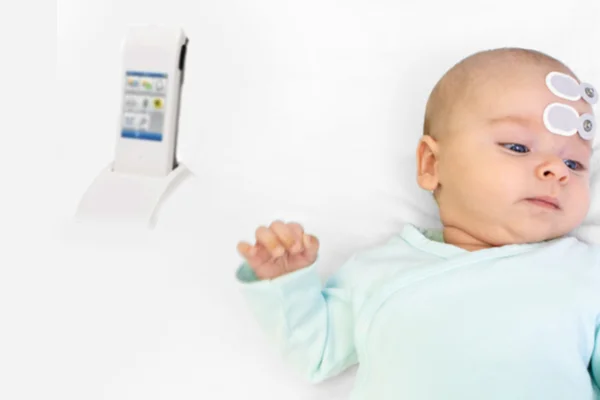
BERA and ASSR testing are advanced objective hearing assessments that help audiologists evaluate hearing ability when conventional hearing tests may not provide reliable results. At Clear Talk Speech and Hearing Centre, BERA & ASSR testing in Gurugram is used to assess hearing responses in children, infants and adults who may have difficulty responding to behavioural hearing tests.
These tests can provide important information about hearing sensitivity and help audiologists understand the possible degree and nature of hearing loss. They may be recommended as part of a comprehensive hearing evaluation, particularly when accurate hearing information is required for further management.
BERA, or Brainstem Evoked Response Audiometry, is an objective test that measures the electrical responses generated by the auditory pathway and brainstem when sound is presented to the ears.
Small electrodes are placed on the patient's head to record these responses. Sounds are delivered through earphones or other suitable transducers, and the equipment records the resulting electrical activity.
Because BERA does not require the patient to actively indicate whether they heard a sound, it can be particularly useful for infants, young children and individuals who cannot provide consistent behavioural responses.
ASSR, or Auditory Steady-State Response testing, is another objective hearing assessment. It uses sound stimuli to measure the brain's electrical response and can help estimate hearing thresholds at different frequencies.
ASSR can be useful when an audiologist needs frequency-specific information about hearing sensitivity, especially in individuals who cannot reliably participate in conventional pure-tone testing.
The results can contribute to a more detailed understanding of hearing levels and may assist in hearing aid evaluation and other hearing-care decisions.
Traditional hearing tests often depend on the patient responding to sounds. This can be difficult for babies, very young children or individuals with certain developmental or communication difficulties.
BERA and ASSR provide objective information without requiring the patient to raise a hand, press a button or verbally identify sounds.
They can help:
Early identification of hearing loss is important because hearing plays an essential role in speech, language and communication development.
BERA testing may be recommended when a baby or child has risk factors for hearing loss, has not achieved expected hearing milestones or has produced inconclusive results during other hearing assessments.
Since the test is objective, it can provide useful information even when a child is too young to respond consistently to conventional hearing tests.
ASSR can provide frequency-specific information about hearing sensitivity. This may be particularly useful when assessing children who are unable to participate reliably in behavioural audiometry.
The audiologist considers ASSR findings along with the child's history, other hearing test results and clinical observations before determining the appropriate hearing-care plan.
Before the test, the audiologist may examine the ears and discuss the patient's hearing history.
Small electrodes are placed on the scalp and forehead to record the electrical responses associated with auditory stimulation. Sounds are then presented through appropriate earphones or inserts.
The patient needs to remain relaxed and still during the recording. Depending on the age of the patient and the testing requirements, the assessment may be performed while the child is naturally asleep or in another suitable state as advised by the audiologist.
The recorded responses are analysed to understand how the auditory pathway responds to sound.
ASSR also uses electrodes to record electrical brain responses to auditory stimulation. The patient receives carefully controlled sounds through suitable earphones or inserts while the equipment records the responses.
The testing process is designed to provide objective, frequency-specific information about hearing sensitivity.
The audiologist interprets the results along with other relevant hearing assessments to understand the patient's overall hearing status.
Although both BERA and ASSR are objective hearing tests, they provide different types of information.
BERA evaluates electrical responses associated with auditory nerve and brainstem activity and can provide useful information about auditory pathway function.
ASSR is designed to estimate hearing thresholds at specific frequencies and can provide detailed frequency-specific information.
Depending on the patient's age, hearing concerns and testing requirements, an audiologist may recommend one test or both.
BERA and ASSR may be considered when:
The exact testing approach depends on the individual patient's requirements.
Undetected hearing difficulties can affect communication, speech and language development, particularly during early childhood.
Objective hearing assessments such as BERA and ASSR can help provide useful information when conventional testing is difficult. Early evaluation allows parents and healthcare professionals to better understand a child's hearing needs and determine whether additional assessment or hearing support may be appropriate.
At Clear Talk Speech and Hearing Centre, BERA & ASSR testing in Gurugram is offered as part of comprehensive audiological assessment for children and adults.
Our audiology approach focuses on selecting appropriate tests according to the patient's age, hearing concerns and ability to participate in conventional assessments. BERA and ASSR may also be considered alongside tests such as OAE, Pure Tone Audiometry and Impedance Testing when a broader evaluation is required.
The results are interpreted carefully to help patients and families understand their hearing assessment and the next steps in hearing care.
BERA and ASSR testing are valuable objective hearing assessments that can provide important information when conventional hearing tests are difficult to perform or interpret. BERA evaluates auditory pathway responses, while ASSR can provide frequency-specific information about hearing sensitivity.
If you are looking for BERA & ASSR testing in Gurugram, Clear Talk Speech and Hearing Centre provides professional audiological assessment for children and adults. A suitable testing approach can help provide a clearer understanding of hearing ability and support appropriate hearing-care planning.
BERA is an objective hearing test that records electrical responses from the auditory pathway and brainstem when sound is presented to the ears.
ASSR is an objective hearing assessment that helps estimate hearing thresholds at different frequencies by recording the brain's electrical responses to sound.
Yes. Both tests can be useful for assessing hearing in babies and young children who cannot reliably respond to conventional hearing tests.
No. These tests are non-invasive and generally painless. Small electrodes are placed on the skin to record auditory responses.
BERA primarily evaluates auditory pathway and brainstem responses, while ASSR can provide frequency-specific estimates of hearing sensitivity.
The duration varies depending on the patient's age, testing requirements and whether one or both assessments are performed.


Write a Reply or Comment